
Why Sales Are Not Profit: A Naira Cost of Goods Sold Example
Olamide Ademola · · 8 min read
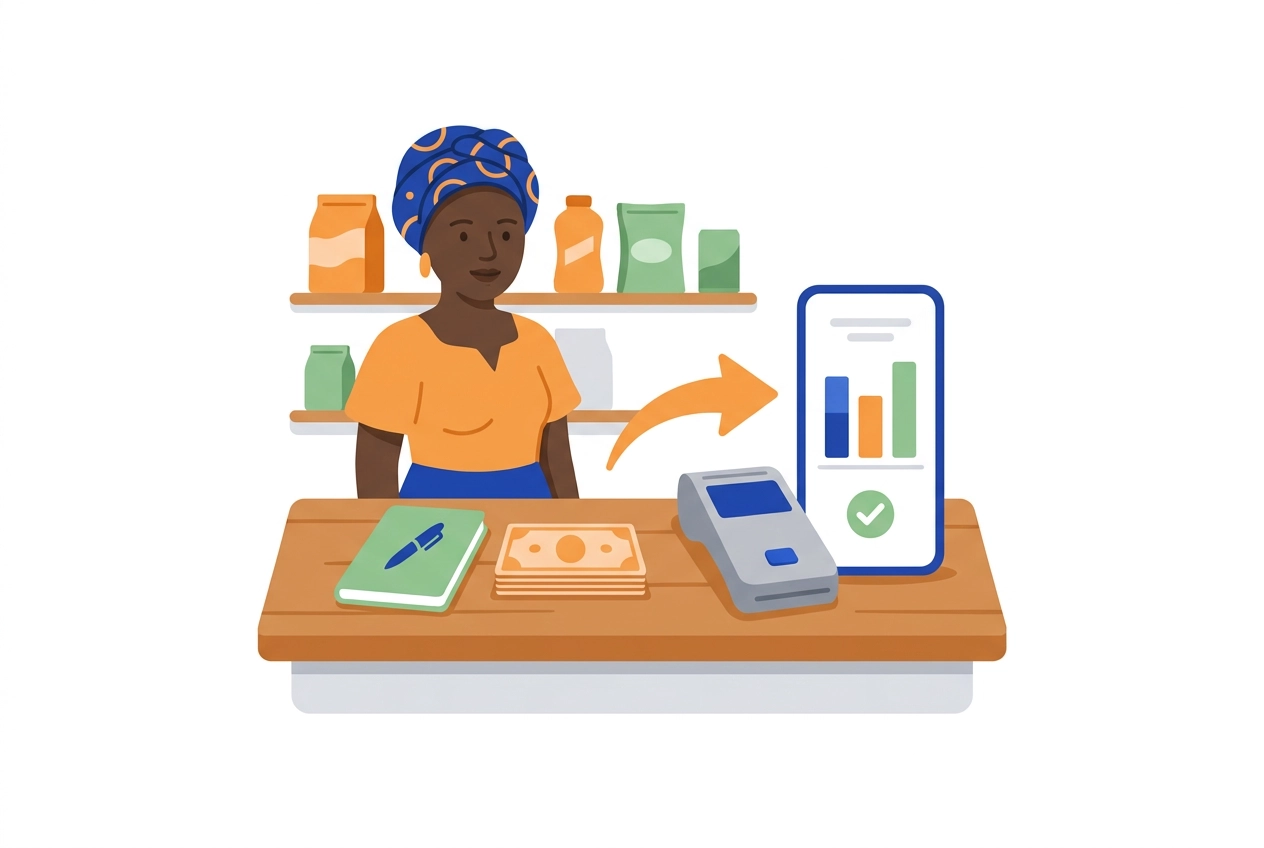
You sold well this week. So why is there nothing left to restock?
Money entered your hand all week. You paid rent, bought fuel for the generator, paid transport to market and settled your two shop helpers. You count what remains and smile. But is that your profit? Many small business owners in Nigeria make the same mistake: they take sales, subtract the everyday expenses, and call the rest profit. It is not, until the cost of the goods you sold comes out too.
This guide shows how to calculate profit for a small business in Nigeria with one worked week in naira, explains cost of goods sold in plain words, covers four mistakes that hide the truth, and ends with one habit that shows you what the shop really kept.
Why Big Sales Can Still Leave Your Shop With No Money
Sales is the money customers hand over your counter. Profit is what is still yours after every cost has been paid. Two shops can sell the same ₦450,000 in a week and end it in completely different places. One owner restocks on Monday morning; the other is dodging the supplier's calls.
You know that week. The counter was busy from morning till night. Transfers landed one after another. Yet by Monday the shelves looked thin and there was nothing in the drawer to buy more. Here is why: the goods that left your shelf already carried a cost. You paid for them weeks earlier.
Rent, fuel, transport and salaries are real money out, but they are only part of the story. In most small shops the single biggest outflow is the stock itself, and that money left long before the sales came in.
Sales minus running costs feels like profit. It is not. It leaves out the cost of the goods that were actually sold, so the number looks big while the drawer stays small. Money spent on stock is not a loss, and cash sitting in the drawer is not profit. Both are the same money at different stages.
If your shelves and your records never agree, that gap is often where the money hides; these five plain habits keep your count and your money honest.
The naira figures in this post are an example to show the sums, not survey data.
What Cost of Goods Sold Means in Plain Words
Cost of goods sold is the money you paid for the exact goods that have now left your shelf and been sold. Not the goods still in the store. Not the goods you have ordered. Only what has gone out of the door.
Say you bought a bag of rice for ₦60,000 and sold it for ₦68,000. Your cost of goods sold for that bag is ₦60,000. A crate of drinks bought at ₦4,500 and sold at ₦5,500 carries ₦4,500. Multiply each by the number sold, add them up, and you have the week's figure.
Rent, generator fuel, transport to market, salaries and data are running costs. You pay them to keep the shop open. They are real, but they are not the cost of the goods sold. Under general accounting rules for inventory, the purchase price and the transport that brings goods to your shelf belong to what the goods cost you; storage and selling costs do not.
Sales minus cost of goods sold gives gross profit. Gross profit minus running costs gives net profit. That last number, not the first, is what the shop actually earned.
A Naira Worked Example: One Week in a Small Provision Shop
Here is one week in a small provision shop.
What was sold (₦450,000 in sales):
- 4 bags of rice at ₦68,000 each: ₦272,000
- 20 crates of drinks at ₦5,500 each: ₦110,000
- Noodles, milk, sugar and other provisions: ₦68,000
What those exact goods cost the owner (₦385,000):
- 4 bags of rice at ₦60,000 each: ₦240,000
- 20 crates of drinks at ₦4,500 each: ₦90,000
- The provisions sold: ₦55,000
Gross profit: ₦450,000 − ₦385,000 = ₦65,000
Running costs for the week (₦50,000): the week's share of rent ₦12,000, generator fuel ₦15,000, transport to market ₦8,000, and two helpers ₦15,000.
Net profit: ₦65,000 − ₦50,000 = ₦15,000
Now the common way of counting: ₦450,000 in sales minus ₦50,000 in running costs leaves ₦400,000, and the owner feels rich. But ₦385,000 of that has to go back to the supplier just to put the same goods on the shelf again. What the shop actually kept this week is ₦15,000.
That is not bad news. It is the real number, and it tells the owner exactly where to look: rice brings in the most sales but has the thinnest margin, ₦8,000 on a ₦68,000 bag. If the supplier raises rice by ₦8,000 and the shelf price stays the same, every bag sells for no profit at all.
Where the Money Really Goes: Four Mistakes That Hide the Truth
That example shows the sums. The reason many owners never see them is four common mistakes.
Mistake 1: Treating restocking as a one-off loss. You pay ₦500,000 to the supplier and record a heavy loss that week. Then every sale after that looks like pure profit. But the cost belongs to the goods as they sell, not to the day you paid. Stock on the shelf is not a loss yet. It becomes cost of goods sold only when it leaves the door.
Mistake 2: Mixing shop money and personal money. When school fees, family transport and stock purchases come from the same purse or account, nobody can tell what the business earned. Separate them.
Mistake 3: Using old cost prices. You bought rice at ₦60,000 in January. In March you restock at ₦72,000 but keep selling at the old price. You are quietly selling at a loss. Update your cost price each time you buy.
Mistake 4: Counting credit sales as money in hand. A credit sale is a sale, but the cash is still with the customer. Until it is collected, it cannot pay for restocking. Treat it as money owed, not money available.
Then there is dead stock: spoilage, breakage, expired goods and items customers stop buying. That money was spent and will never come back through the till. It belongs in your reckoning too.
The Habit That Keeps You Honest: Record Every Money Out the Same Day

Record every money out on the day it happens. Not at month end when receipts are lost. Not from memory on Friday. The day it happens is the only time you still know exactly what it was for.
Keep it in one place and make it take seconds: a notebook at the counter, a note on your phone, or the app you already use. It should sit beside your sales figures, not in a separate pile.
Write four things every time: the date, what you bought, how much you paid, and what it was for. Use simple tags such as stock, transport, fuel, salary or personal. That one word tells you later whether the money went into goods or into running costs. ₦2,000 of transport is not the same as ₦2,000 of stock.
Set a short weekly review, about fifteen minutes every Sunday. Add up the week's sales, the cost of goods sold and the running costs. Write down the one number that matters: what the shop actually kept. Do it before Monday, when the supplier starts calling.
A habit with a few gaps still beats a tidy record you never keep. Start with today's expenses.
Where Anvela Fits: Money Out Beside Your Sales
The habit only works if the record sits in one place.
Anvela has a Money out book where rent, fuel, transport, salaries and other spending go in with one tap, and the owner sees sales less money out in the same place. No more adding up a notebook on one side and trying to recall sales on the other.
Keep your cost prices current too. When your supplier raises the price of a carton or a bag, update it once in Anvela. If you keep your books in Anvela, Money › Overview shows gross profit by month, sales less what the items cost you, and Stock value lets you check your prices against your costs. Old cost prices are how shops sell at a loss without noticing.
Anvela works on the web and on the phone, so you record at the counter while the transaction is fresh, not later at home when the details are gone.
Start With One Honest Week
The aim is not perfect books. It is one honest week. Sales are not profit. The cost of the goods you sold comes out first, then your running costs, and only what is left is yours to keep. In the example above, ₦450,000 in sales left ₦15,000.
Do three things this week:
- Record every money out the same day it happens.
- Tag each one as stock or running cost.
- Spend fifteen minutes on Sunday adding up sales, cost of goods sold and running costs.
If the number is smaller than you expected, that is not bad news. It is the first time you have seen the real one, and every decision you make from here gets easier.
Start free at https://anvela.ng, free until 12 January 2027. Need a hand setting it up? WhatsApp +234 814 062 7278 or ask for a phone call.
- Profit
- Money
- Running a business
Home · Start free · Anvela Market · About · Privacy